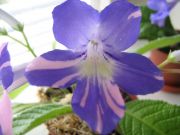
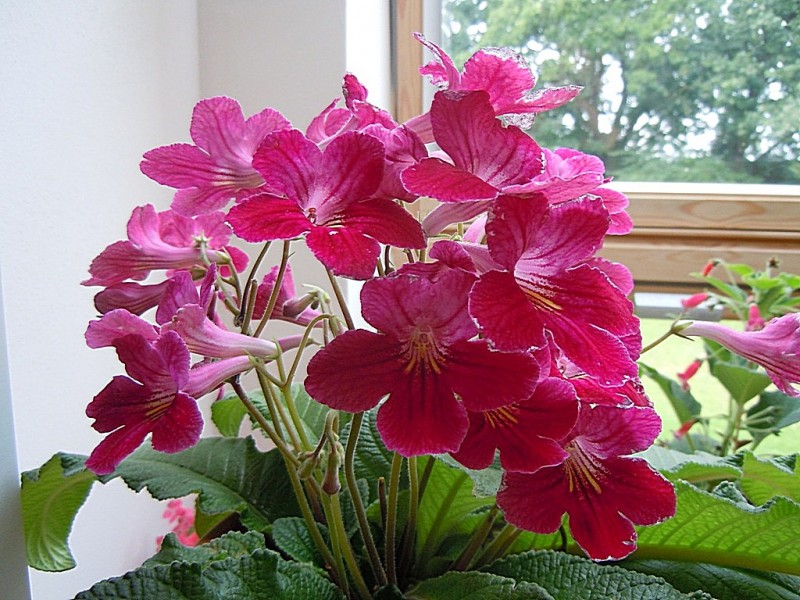
Gesneriaceae is a family of flowering plants consisting of ca. 150 genera and ca. 3200 species in the Old World and New World tropics and subtropics, with a very small number extending to temperate areas. Many species have colorful and showy flowers and are cultivated as ornamental plants.
Most species are perennial herbs or subshrubs but a few are woody shrubs or small trees. Several genera in the family have become popular as houseplants. The most familiar members of the family to gardeners are the African Violets in the genus Saintpaulia. Gesneriads are divided culturally into three groups on the basis of whether, and how, their stems are modified into storage organs: rhizomatous, tuberous, and "fibrous-rooted", meaning those that lack such storage structures (although all gesneriads have fibrous roots).
Botanists who have made significant contributions to the systematics of the family are George Bentham, Robert Brown, B.L. Burtt, C.B. Clarke, Olive M. Hilliard, Joseph Dalton Hooker, William Jackson Hooker, Karl Fritsch, Elmer Drew Merrill, Harold E. Moore, Jr., John L. Clark, Conrad Vernon Morton, Henry Nicholas Ridley, Laurence Skog, W.T. Wang, Anton Weber, and Hans Wiehler. Several researchers are currently working on this group and the generic classification has been changing rapidly.
The family name is based on the genus Gesneria, which honors Swiss humanist Conrad Gessner.
(From Wikipedia, the free encyclopedia)